

Key Takeaways: Vanity Traffic vs. Real Conversions
- Traffic Isn’t Revenue: AI Overviews now answer broad informational queries directly on the results page, making generic top-of-funnel content a dead end.
- Authority Is Finite: Every domain has a limited amount of ranking bandwidth, spend it on pages that convert, not pages that just rack up pageviews.
- Audit Before You Publish: Sometimes the fastest path to page one is optimizing an article you already have, not writing a new one.
- Intent Beats Volume: 2,000 high-intent visitors will outperform 50,000 passive readers, every time.
For over a decade, the SEO playbook was basically the same for everyone: write a mountain of “What is X” and “How to do Y” content, funnel in as much traffic as humanly possible, and pray that some tiny sliver of it eventually converts. It worked, sort of, in the same way throwing spaghetti at a wall “works.” You get a few noodles to stick. You also get a wall covered in sauce and no real plan.
That playbook is dead. Not dying, dead. And if you’re still building content strategy around it in 2026, you’re optimizing for a search engine that doesn’t really exist anymore.
1. The Shifting Value of Top-of-Funnel Content
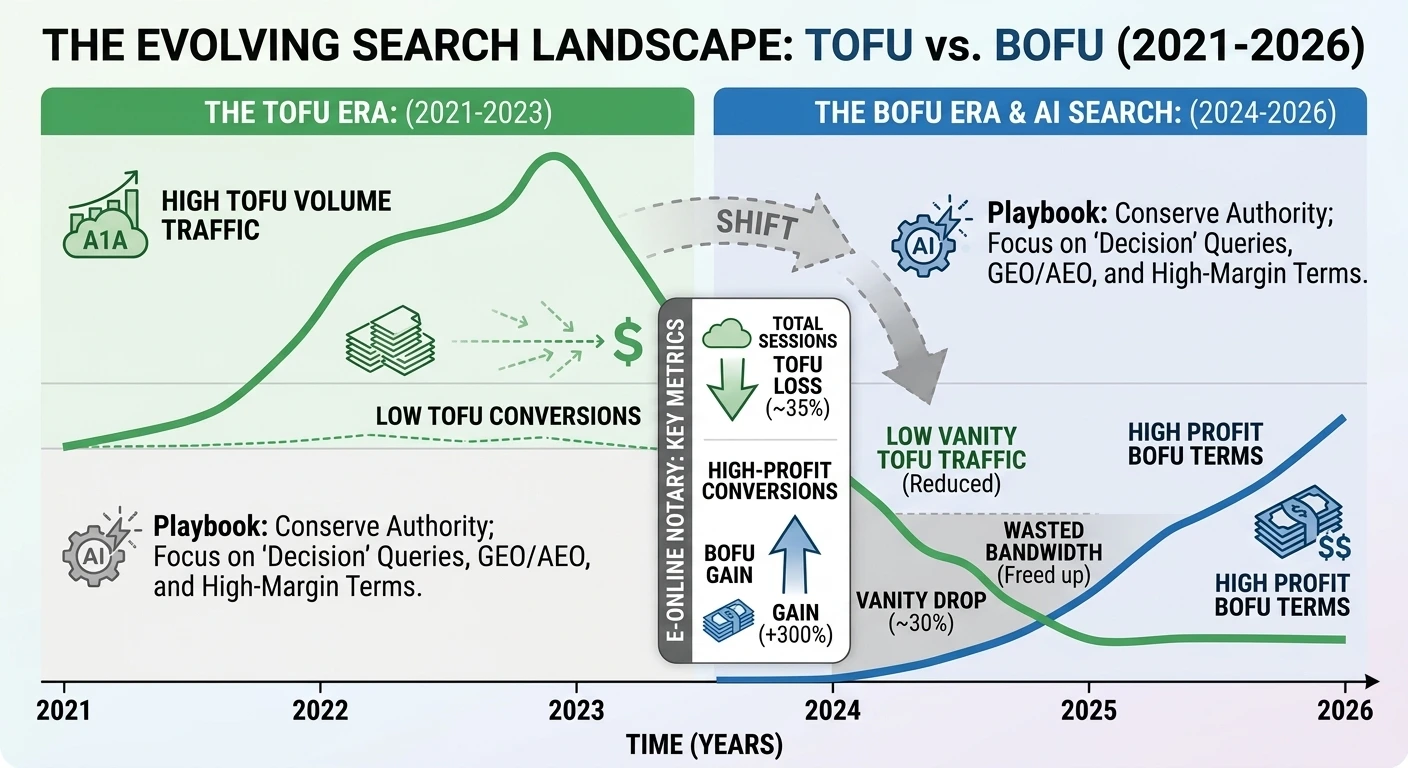
Here’s the uncomfortable truth: AI Overviews, generative engines, and LLM-driven search now just answer the question, right there on the results page. No click required. That “Ultimate Guide to X” you spent 3,000 words and a full content sprint on? The AI reads it, digests it, and hands the answer to the user before they ever see your site. You did the work. The bot got the credit. The user never showed up.
The Old Playbook vs. The New Reality:
- The Legacy Playbook: Publish massive volumes of broad informational content, collect maximum traffic, and hope a small percentage trickles down to convert.
- The AI SERP Reality: Generative engines, AI Overviews, and LLM-driven search now answer broad informational queries directly on the results page, before a click ever happens.
- The Core Problem: Chasing generic top-of-funnel volume yields high pageviews with near-zero business impact, while consuming the domain authority and internal ranking power your money pages actually need.
If you want the fuller breakdown of how this shift plays out mechanically, I wrote a whole piece on AEO vs. SEO in 2026, worth a read after this one.
2. Real-World Case Study: What Happens When You Cut the Fat
About a year ago, I made a call on one of my client sites, a business in a licensed, service-based industry, that probably looked insane on paper: stop publishing broad informational content. Not “slow down.” Stop. Full pivot to high-intent, bottom-of-funnel assets only.
The Data Breakdown:
- Traffic Impact: Overall organic sessions dropped roughly 30-35%. Yes, that’s a big number. Yes, it looks bad on a screenshot. No, I didn’t panic.
- The Hidden Win: By cutting the vanity traffic loose, we freed up a ton of crawl equity, internal link authority, and topical focus that had been getting spread thin across pages nobody was ever going to buy from.
- Revenue Impact: The site broke through and locked in top-tier rankings for 3 to 6 critical, ultra-high-margin transactional terms that had been stuck for ages. Total traffic went down. Actual conversions and qualified leads went up. Noticeably.
Let that sink in for a second. We killed a third of the traffic on purpose and the business got healthier. If you’re still reporting “sessions” as your headline KPI to a client or a boss, this is your sign to stop. This isn’t a one-off fluke either, you can dig through more real examples like this on our case studies page.
3. The Mechanics: Authority Conservation and Intent Compression
So why does gutting your traffic actually work? A few reasons, and none of them are magic, it’s just math.
Why This Works:
- Topical Focus Over Volume: Publishing hundreds of thin, loosely-related informational pages dilutes your site’s core entity focus. Search engines and generative engines alike are trying to figure out what you actually are. Every off-topic post you publish muddies that signal.
- Conserving Ranking Bandwidth: Every domain has a finite amount of authority to throw around. Full stop. There’s no infinite well. Every bit of internal link equity and optimization effort you spend on a generic blog post is equity you’re not spending on the page that actually closes deals.
- Intent Beats Traffic, Every Time: A site pulling in 2,000 highly targeted, decision-ready visitors will run circles around a site pulling 50,000 passive readers who were never going to buy anything. Pageviews don’t pay invoices. Conversions do.
4. Strategic Considerations for Modern Search
Now, before you go nuke your entire blog, slow down. This isn’t a “delete everything” strategy, it’s a filter.
Where to Focus:
- Contextual Content Selection: Some industries and long-cycle B2B models genuinely still benefit from mid-funnel, educational content. The key isn’t “never write informational content,” it’s running every single piece through an intent-and-conversion lens instead of chasing keyword volume for its own sake.
- Auditing Existing Assets: Go through what you’ve already got. Find the low-value informational bloat that’s quietly siphoning authority away from your core commercial pages, and prune or consolidate it. Yes, this means admitting some of your past work isn’t earning its keep. Get over it.
- Structuring for Answer Engines: Make sure your transactional and core solution pages are doing the heavy lifting, clear entity declarations, factual schema architecture, and clean structured data, so that when a high-intent user hits a decision-stage query, the AI cites your brand instead of a competitor’s.
And here’s the part I’ll die on a hill for: sometimes the right move isn’t writing anything new at all. Everybody wants to hit publish on a fresh article, it feels like progress. But half the time, the smarter play is going back into something you already have, an article sitting on page two, already getting a little traction, already halfway there, and pushing it over the top instead. Tighten the entity signals, add real depth, build some links and authority into it, and get it to page one.
Instead, most people are stuck on a content-spew hamster wheel, cranking out article after article, half of it AI-generated with zero real editing, then wondering why none of it ranks. You don’t have a content problem. You have an authority problem. You’re sitting on a stack of pages with decent bones, and instead of building them up, you’re burying them under more noise.
Run the audit before you run the content calendar. And if you’re already leaning on agentic workflows for your content ops, this is exactly the kind of repetitive, high-leverage grunt work you can hand off to them, I broke down how we use them for that in this piece on OpenClaw for business. If this kind of audit-and-authority-building work is something you need help with, it’s core to what we do, check out our services.
Key Takeaway: Measure Outcomes, Not Clicks
Here’s the thing nobody wants to hear: raw traffic numbers have always been a vanity metric. AI search just made that impossible to ignore anymore. In this new GEO landscape, authority, precision targeting, and actual bottom-line conversions matter infinitely more than total pageviews ever did. So if your monthly report still leads with a traffic chart and nothing about what that traffic actually did for the business, it’s time for a new report.
Struggling to Balance ToFu and BoFu?
If your enterprise is stuck trying to balance top-of-funnel and bottom-of-funnel content, and you’re not sure whether the answer is pruning, auditing, or building something new, that’s a conversation worth having. Get in touch and let’s figure out where your authority is actually leaking.