Table of Contents
- The Shift from Search to Answer Engines
- Why Traditional SEO is Failing Local Business
- The Three Pillars of AI Visibility
- Internal Linking and Authority
- Frequently Asked Questions
The Shift from Search to Answer Engines
The era of the “10 Blue Links” is effectively over. When a potential customer searches for a service today, they aren’t just looking for a list of websites; they are looking for a recommendation. AI models like Gemini, ChatGPT, and Perplexity are becoming “Answer Engines.”
For a local business, this means your website needs to be more than a digital brochure. It needs to be a Data Source. If the AI cannot easily extract your pricing, service area, and unique value proposition, you simply won’t be cited in the final answer.
Why Traditional SEO is Failing Local Business
In the past, you could “game” the system with high keyword density and a few backlinks. Today, search engines use Natural Language Processing (NLP) to understand the intent behind a query. According to industry leaders at Search Engine Journal, the focus has shifted toward “Information Gain.” If your content doesn’t provide new, unique information that the AI can’t find elsewhere, you’re invisible.
The Three Pillars of AI Visibility
To win in this new landscape, you need to focus on three specific areas:
1. Entity Authority
You need to define your business as an “Entity” rather than just a keyword. This means having consistent data across your site, your social profiles, and third-party directories. The AI cross-references this data to verify your legitimacy.
2. Structured FAQ Data
AI models love “Question-Answer” pairs. By using structured FAQ schema, you are essentially hand-feeding the AI the exact answers you want it to give to customers. This is a core part of our GEO Blueprint Pricing strategy.
3. Hyper-Local Citations
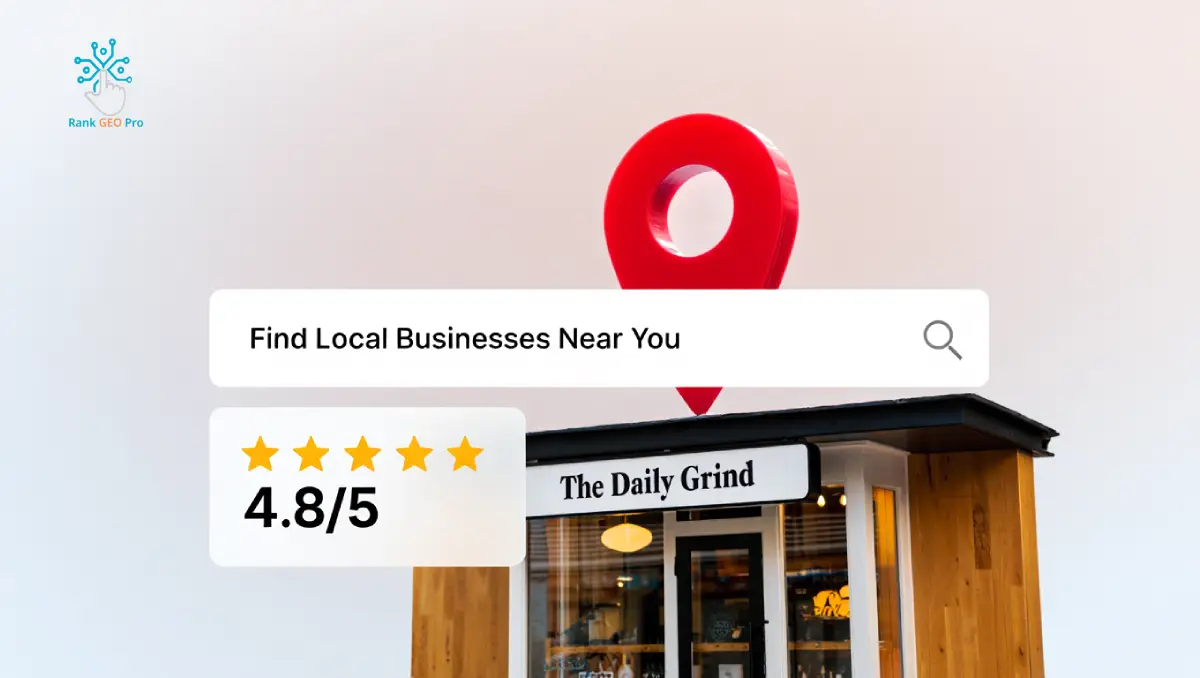
Even in the AI age, local relevance is king. Mentioning specific landmarks, local neighborhoods, and community events helps the AI anchor your “Entity” to a specific geographic location. As noted by The Verge, the integration of local maps into AI snapshots is the next frontier of mobile search.
Internal Linking and Authority
One of the biggest mistakes local businesses make is “Orphan Pages”-pages with no links pointing to them. A strong internal linking structure tells the AI which pages are the most important. Notice how we link our strategy back to our services? That’s not just for users; it’s a roadmap for the crawler.
Frequently Asked Questions
Q: What is GEO? A: Generative Engine Optimization (GEO) is the process of optimizing your website to be cited and recommended by AI-powered search engines.
Q: Does GEO replace SEO? A: No, GEO builds upon SEO. Think of SEO as the foundation and GEO as the advanced engine that powers visibility in AI snapshots.
Q: How long does it take to see results? A: While traditional SEO can take months, AI models update their training data and real-time search capabilities frequently. Strategic changes can often be reflected in AI answers within weeks.