
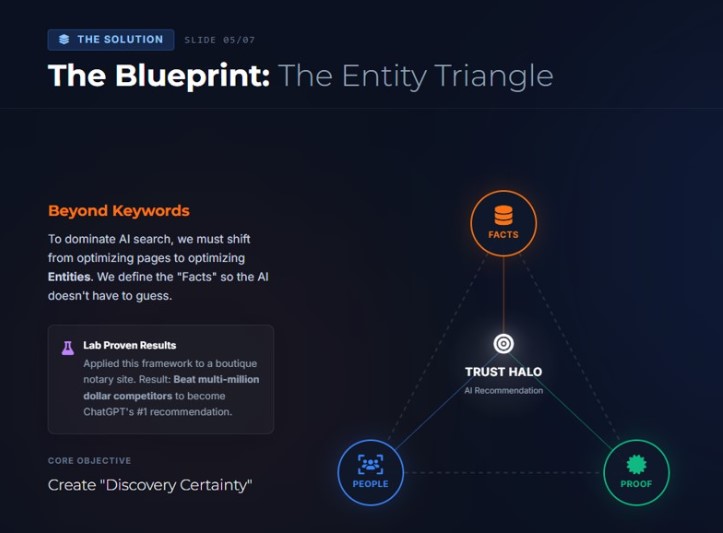
The Entity Triangle Framework: How to Hard-Code Your Authority
Key Takeaways (GEO Hook)
- The Core Problem: AI engines like Gemini and ChatGPT don’t rank websites — they cite verified entities. If you’re not structured as one, you’re invisible.
- The Framework: The Entity Triangle connects three JSON-LD nodes — Person, Organization, and Evidence — into a single, interlocked Knowledge Graph signal.
- The Mechanism: Linked
@idreferences,sameAsverification chains, andknowsAboutdeclarations tell AI models exactly who you are, what you know, and why you’re credible. - The Result: Higher citation frequency in AI Overviews, Google AI Mode, Gemini snapshots, and ChatGPT responses — without chasing a single new backlink.
The Shift Has Already Happened
I basically developed this framework as almost a checklist for the question: is our content citation worthy in AI eyes? What this framework does is force your content to get cited by AI, because it packages together everything that LLMs are looking for when they directly cite content. It wants authority, it wants facts, and it wants third party verification. This framework solves that problem by spoon feeding the LLMs exactly what they’re looking for and making you and your content the atomic truth.
This distinction is everything. A keyword can be faked with density, backlinks, or anchor text manipulation. An entity cannot. Either the AI has a high-confidence, cross-validated representation of your brand — or it doesn’t. If it doesn’t, you don’t get cited. It’s that binary.
This is the problem the Entity Triangle Framework was built to solve. It’s not a content strategy. It’s not a link-building play. It’s a structured data architecture that hard-codes your authority directly into the knowledge layer that AI models use to answer questions. By the end of this article, you’ll understand exactly how to build it.
What Is Generative Engine Optimization (GEO)?
Before we get into the framework, let’s define the playing field. Generative Engine Optimization (GEO) is the discipline of optimizing your digital presence to be cited, quoted, and recommended by AI-driven answer engines — not just ranked in traditional SERPs.
Where classical SEO asked: “How do I rank for this keyword?”, GEO asks: “How do I become the source an AI model trusts when someone asks about my niche?”
The technical answer is: by becoming a well-defined, cross-validated, semantically rich entity in the knowledge graph. AI systems like Google’s Search Generative Experience, AI Overviews, and Gemini’s conversational mode don’t pull from a ranked list of pages. They pull from a structured understanding of the world that has been built over years from authoritative sources, structured data, and verifiable signals. Your job is to insert your brand into that model — precisely and provably.
GEO encompasses several adjacent disciplines: Answer Engine Optimization (AEO), Large Language Model Optimization (LLMO), and AI search visibility — but they all share the same foundational requirement: entity clarity. If an AI model cannot confidently identify who you are, what you do, and why you’re qualified, it will not cite you. Full stop.
The Entity Triangle: Three Nodes, One Coherent Identity
The Entity Triangle Framework is built around a simple but powerful insight: AI search engines hate ambiguity. The more clearly and completely you define yourself — and the more tightly your data points cross-reference each other — the higher your entity trust score becomes.
The triangle has three vertices:
Vertex 1: The Person (The Expert Node)
This is the human intelligence behind the brand. In JSON-LD, this is a Person schema type that declares:
name— your full legal name as a stringjobTitle— your role with precision (e.g., “Generative Engine Optimization Specialist”, not just “SEO”)knowsAbout— a curated array of 3-5 topical entities you want AI models to associate with you (e.g.,"Knowledge Graph Optimization","Entity-Based SEO","JSON-LD Schema Architecture")sameAs— an array of external profile URLs: LinkedIn, X/Twitter, Google Scholar, Crunchbase, authoritative guest posts
The knowsAbout field is vastly underutilized and underestimated. It’s a direct declaration to the AI’s ingestion pipeline: “When a user asks about these topics, I am a relevant authority.” Most SEOs are leaving this on the table entirely.
Vertex 2: The Organization (The Brand Node)
This is the legal and operational entity your expertise lives within. In JSON-LD, this is an Organization or LocalBusiness schema type that declares:
legalName— your full registered business namefounder— a reference (via@id) back to the Person node, not a repeated string. This cross-link is critical.brand— the commercial identity of the organizationurl— the canonical homepagesameAs— Google Business Profile URL, LinkedIn company page, BBB listing, industry directories
The link from Organization back to Person via @id is not cosmetic. It’s the mechanism by which the AI model understands that the expert and the company are the same entity-cluster — not two separate, potentially unrelated data points.
Vertex 3: The Evidence (The Proof Node)
This is the third vertex most practitioners skip, and it’s the one that converts a declared identity into a verified one. The Evidence node is built from two sub-components:
AggregateRating — Nested inside your Person or Service schema, this tells the AI your social proof in machine-readable form: ratingValue, reviewCount, and bestRating. AI models treat review signals as external validation — third-party corroboration that your entity claims are accurate.
External Asset References — Case studies, published work, media mentions, and external citations linked back to your @id. These are the proof artifacts: the things you’ve actually done that validate what your schema says. The matching rule is iron law here — what the schema declares and what the on-page content actually says must align perfectly. Self-serving hallucinations in structured data erode trust rather than build it.
The Identity Loop: How the Three Nodes Connect
The power of this framework isn’t in any single node — it’s in the connections between them. Here is the logic chain, called the Identity Loop, that you build into your JSON-LD:
- Define the Person. “This is Jeremy McDonell.”
- Define the Expertise. “Jeremy McDonell is an authority on Entity-Based SEO, GEO, and Knowledge Graph Optimization.” (via
knowsAbout) - Bridge to the Brand. “Jeremy McDonell is the founder of Rank GEO Pro.” (via
founder->@idreference) - Validate with Third Parties. “This is the same Jeremy McDonell as [LinkedIn profile], [X account], [Search Engine Land author page].” (via
sameAs) - Inject the Evidence. “Rank GEO Pro has a 4.9 rating from 87 verified clients.” (via
AggregateRatingnested in the Organization node)
Each step reduces the AI model’s uncertainty by one degree. By the time you’ve completed the loop, the model doesn’t have to guess who you are or infer your credibility from surrounding signals. You’ve declared it, cross-referenced it, and proven it — in the language the AI was literally trained to parse.
The “Beast Mode” JSON-LD Implementation
Below is the complete @graph structure that implements the Entity Triangle. The @graph container is the critical architectural choice: it packages all three nodes into a single JSON-LD object so the AI model processes them as one coherent story, not three separate, disconnected schema blocks.
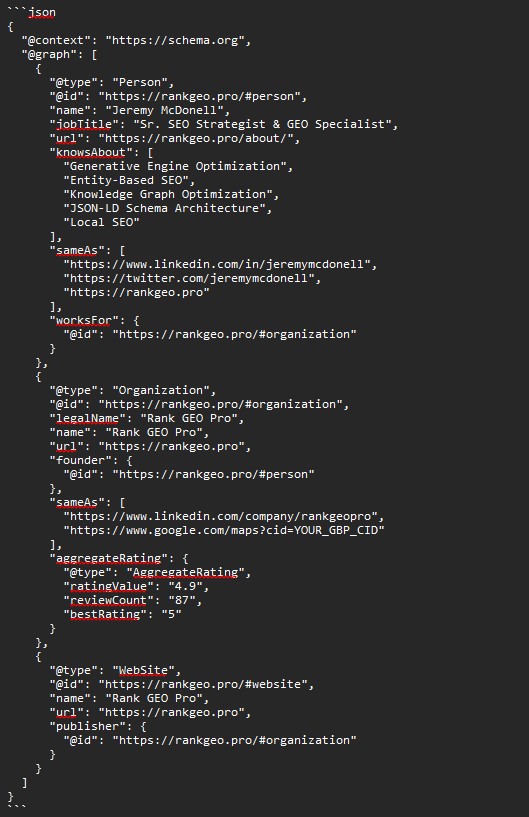
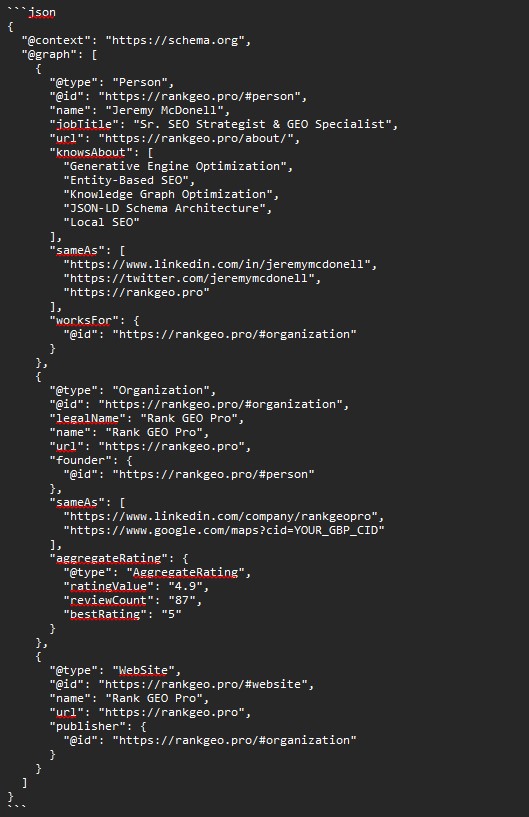
Every @id is a unique, stable URL fragment that acts as a globally unique identifier for that entity. The cross-references between nodes — founder pointing to /#person, publisher pointing to /#organization — are what transform three isolated schema blocks into a connected knowledge graph. This is the structural difference between schema markup and entity markup.
The No-Fail Entity Checklist
Before you deploy any Entity Triangle implementation, run every project through this checklist. Missing even one item significantly reduces the confidence signal you’re sending to the AI model.
The @id Rule: Does every major entity node have a unique, stable @id in URL fragment format? (e.g., https://yourdomain.com/#person). Without unique IDs, the AI cannot link the nodes. It just sees repeated text.
The sameAs Rule: Have you included at least 3-4 external verification URLs for each major entity? Think LinkedIn, X/Twitter, Crunchbase, authoritative industry directories, and any media appearances. Each sameAs URL is a corroboration signal — external confirmation that your declared identity matches a verified, real-world presence.
The knowsAbout Rule: Have you declared 3-5 precise topical keywords in the Person node’s knowsAbout array? These should be the exact concepts you want AI models to associate with your expertise. Don’t use vague strings like “marketing” — use precise entity-level phrases like “Generative Engine Optimization” or “Local Business Schema Implementation.”
The Matching Rule: Does every claim in your schema have corresponding on-page text that says the same thing? If your jobTitle says “GEO Specialist” but your About page says “Digital Marketer,” the AI model detects the mismatch and reduces your entity confidence score. Schema is not a place to self-serve. It’s a place to declare exactly what is already provably true on the page.
The @graph Container Rule: Are all your entity nodes wrapped in a single @graph array? Separate, standalone schema blocks are processed independently. Only the @graph structure tells the AI model to parse your Person, Organization, and WebSite as a single interconnected entity cluster.
Why the sameAs Chain Is Your Most Underrated GEO Signal
Most practitioners treat sameAs as a minor supplementary field. In the context of AI citation, it is arguably the most powerful signal in your entire structured data stack.
Here’s why: AI models are trained on a web of corroborated facts. When they encounter an entity claim — “Jeremy McDonell is an expert in GEO” — they cross-reference that claim against everything else they know about Jeremy McDonell. If the LinkedIn profile says the same thing, and the X account reinforces it, and a guest post on Search Engine Land cites him on the same topic, the model’s confidence in the entity claim increases substantially.
The sameAs field is the structured data implementation of that corroboration loop. Each URL you include is an instruction to the AI: “Go verify me against this authoritative external source.” The more high-authority external sources confirm your entity claims, the more likely the AI is to treat you as a verified fact rather than a probabilistic guess.
A strong sameAs chain for a local business expert might include: Google Business Profile, LinkedIn personal and company pages, X/Twitter, a Wikipedia page (if applicable), Crunchbase, an industry association directory, and any platforms where you’ve published substantive content (Forbes, Search Engine Land, Entrepreneur, etc.).
For a deeper look at how Google’s entity understanding pipeline processes these signals, the Search Engine Land guide on entity-first SEO and Knowledge Graph alignment is an excellent technical reference.
Entity SEO vs. Traditional SEO: The Fundamental Difference
Understanding what you’re building requires understanding what you’re moving away from. Here’s the core distinction:
Traditional SEO treats your website as a document. The optimization question is: “Which keywords does this document match?” Signals like keyword density, anchor text, and backlink volume are used to rank documents against search queries.
Entity SEO / GEO treats your brand as a node in a knowledge graph. The optimization question is: “How confidently can the AI identify, verify, and trust this entity?” Signals like @id cross-references, sameAs verification chains, knowsAbout declarations, and on-page/schema alignment are used to establish entity certainty.
The practical consequence is significant. In a traditional SERP, a well-optimized competitor page can outrank you. In an AI Overview or Gemini snapshot, there is no “ranking” — the AI either trusts your entity enough to cite you, or it doesn’t. You’re not competing for position; you’re competing for a binary citation decision.
This is why entity-based SEO research consistently shows that structured entity signals outperform keyword signals in AI-driven search environments. Content leveraging defined entities combined with structured schema markup improves AI citation probability substantially compared to traditionally optimized pages.
Local Business Applications: The Entity Triangle in Practice
The Entity Triangle Framework is particularly powerful for local businesses because local AI search is the fastest-growing, most citation-dependent segment of GEO. When a user asks Gemini “best [service] in [city],” the AI is not scanning pages for keyword relevance. It’s querying its knowledge graph for local business entities that have strong, verified, cross-corroborated identities.
For a local business implementation, the framework extends as follows:
The Person node declares the owner or lead expert — by name, by expertise (knowsAbout), and by external presence (sameAs). This humanizes the brand entity and creates the expert signal that AI models use to distinguish a genuine local authority from a generic directory listing.
The Organization node uses LocalBusiness schema type (or a more specific subtype like LegalService, MedicalBusiness, HomeAndConstructionBusiness) and includes the full NAP data — Name, Address, Phone — in structured fields. The Google Business Profile URL belongs in the sameAs array here, as does the BBB listing and any relevant chamber of commerce or industry association directory.
The Evidence node — the AggregateRating — is particularly critical for local. AI models weight review signals heavily when making local citation decisions. A reviewCount of 80+ with a ratingValue above 4.8 is a strong corroboration signal that the entity claim (“this is a trusted local business”) is valid.
The NAP consistency rule deserves its own emphasis: the name, address, and phone number in your schema must be character-for-character identical to your Google Business Profile, your website footer, and every directory listing you control. Any discrepancy is an ambiguity signal to the AI, and AI models do not cite ambiguous entities.
Measuring Your Entity Visibility
GEO success is measured differently than traditional SEO. You’re not tracking keyword rankings — you’re tracking citation presence across AI surfaces. Here’s how to measure it:
AI Overview monitoring: Search your brand name, your top service keywords, and your knowsAbout keywords in Google. Note when your brand appears as a cited source in the AI Overview. Track frequency and query types over time.
Gemini and ChatGPT direct queries: Ask these models directly: “Who are the top [your specialty] experts in [your region]?” or “What are the best resources for [your knowsAbout keywords]?” If the Entity Triangle is working, your name and brand should begin appearing in these responses within 4-8 weeks of implementation.
Knowledge Panel triggers: Search your exact brand name and personal name in Google. A Knowledge Panel appearing on the right side of the SERP is one of the strongest signals that your entity has been verified and ingested into the knowledge graph.
Schema validation: Use Google’s Rich Results Test and the Schema Markup Validator at schema.org to verify that your @graph structure is parsing correctly and that all @id cross-references are resolving without errors.
FAQ: Entity Triangle Framework and GEO
Q: Do I need to implement the full @graph container, or can I use separate schema blocks?
A: Technically, separate schema blocks will be parsed, but the @graph container is strongly preferred for GEO. The reason is architectural: separate blocks are processed as independent data points, meaning the AI model may not connect your Person and Organization nodes. The @graph wrapper explicitly instructs the parser to treat all nodes as a single interconnected entity cluster — which is exactly the “one coherent story” signal you need for high entity confidence.
Q: How many sameAs URLs do I need for a strong entity signal?
A: A minimum of 3-4 high-authority external URLs per entity node. For the Person node, prioritize LinkedIn, X/Twitter, and any industry publications where you have authored content. For the Organization node, prioritize Google Business Profile, LinkedIn company page, and niche-relevant directories. The quality and authority of the external URLs matters more than quantity — a sameAs link to your Search Engine Land author profile carries far more entity weight than a link to a generic directory.
Q: Does the knowsAbout array affect my traditional keyword rankings?
A: Indirectly, yes. While knowsAbout is a Person schema property and doesn’t directly influence on-page keyword signals, it does influence the semantic associations the AI model builds between your entity and specific topics. Over time, strong entity-topic associations can improve how the AI weights your pages when generating responses to queries in those topic areas. Think of it as topical authority signaling at the entity level rather than the document level.
Q: How long does it take for entity changes to be reflected in AI citations? A: Entity ingestion timelines vary by AI system. Google’s crawlers typically process new structured data within days to a few weeks, but Knowledge Graph updates can take longer. For Gemini and AI Overviews, meaningful changes in citation frequency are typically observable within 4-8 weeks of a correct Entity Triangle implementation. For ChatGPT, citation changes depend on OpenAI’s training cycle and real-time search index, so timelines are less predictable. Consistency and patience are essential — entity building is a long-term strategic investment, not an overnight tactic.
Q: What’s the difference between Entity SEO and regular Schema Markup?
A: Regular schema markup describes the content of a specific page — a recipe, a product, an event. Entity SEO uses schema to declare and cross-validate the identity of the organization or person behind the content. The key technical difference is the use of persistent @id identifiers and cross-node references. Entity schema isn’t describing a page; it’s asserting a unique, verifiable identity in the knowledge graph and linking it to external corroboration. The @graph architecture, the @id system, and the sameAs chain are what elevate schema from a rich results tactic to a full GEO strategy.
Q: Can small local businesses benefit from the Entity Triangle Framework, or is it only for large brands?
A: Small and mid-sized local businesses arguably have the most to gain. In AI-driven local search, the playing field is entity-based — not budget-based. A solo practitioner with a perfectly implemented Entity Triangle, a strong sameAs chain, and a solid AggregateRating can achieve the same citation frequency as a large competitor with a generic, poorly structured digital presence. Entity clarity is an equalizer, and that’s one of the most compelling arguments for GEO investment at the local level.
Q: Is traditional backlinking still relevant for GEO? A: Yes, but the framing changes. In GEO, the most valuable backlinks are those that reinforce your entity’s topical authority and appear on high-authority domains that are themselves strong entities in the knowledge graph. A link from Search Engine Land, Moz, or a recognized industry association carries significant entity weight because those domains are already verified, trusted entities. Generic high-DR links from irrelevant domains carry far less GEO value than they do in traditional PageRank-based SEO. Prioritize niche-relevant, entity-adjacent citations over raw domain authority.
The Competitive Moat You’re Not Building Yet
The Entity Triangle Framework represents a meaningful shift in how you think about your digital presence. Most of your competitors are still optimizing pages. You have the opportunity to build a verified knowledge graph identity — a representation of your brand that AI models trust enough to cite without hesitation.
The practical steps are well-defined: implement the @graph container, declare your Person and Organization nodes with complete @id references, build out your sameAs verification chain across 4-6 high-authority platforms, populate knowsAbout with your core expertise topics, and nest your AggregateRating as proof of real-world validation.
Stop telling search engines what to rank. Start telling AI models who you are.
When ChatGPT or Gemini gets asked about your specialty — by your next ideal client, in the middle of a decision-making moment — the question is not whether your website is optimized. The question is whether your entity is verified.
Build the triangle. Hard-code the authority. Become the cited source.
Want a full Entity Triangle audit for your business? Get in touch with the Rank GEO Pro team and we’ll map your current entity footprint and identify every gap in your AI citation strategy.